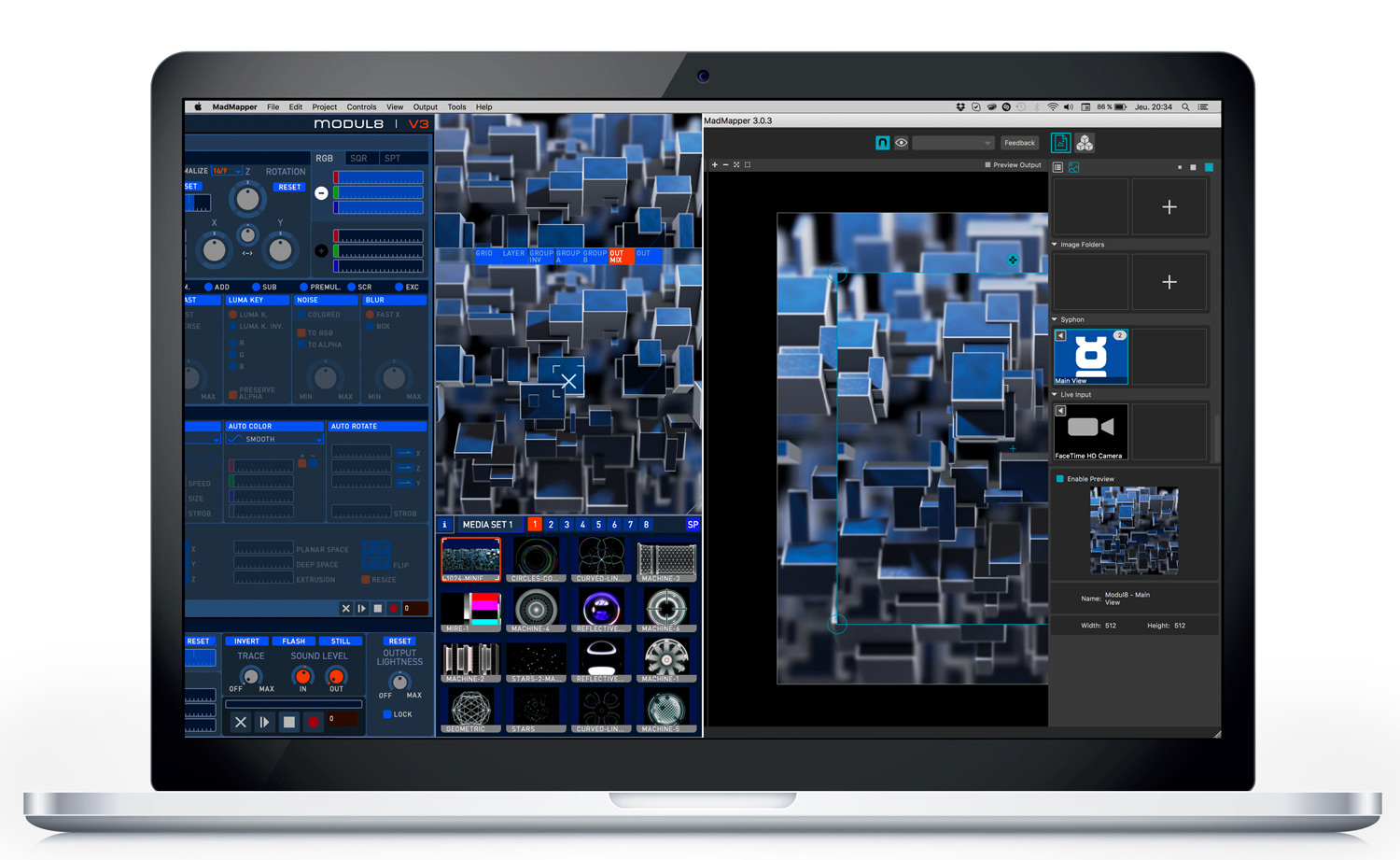
USER INTERFACE

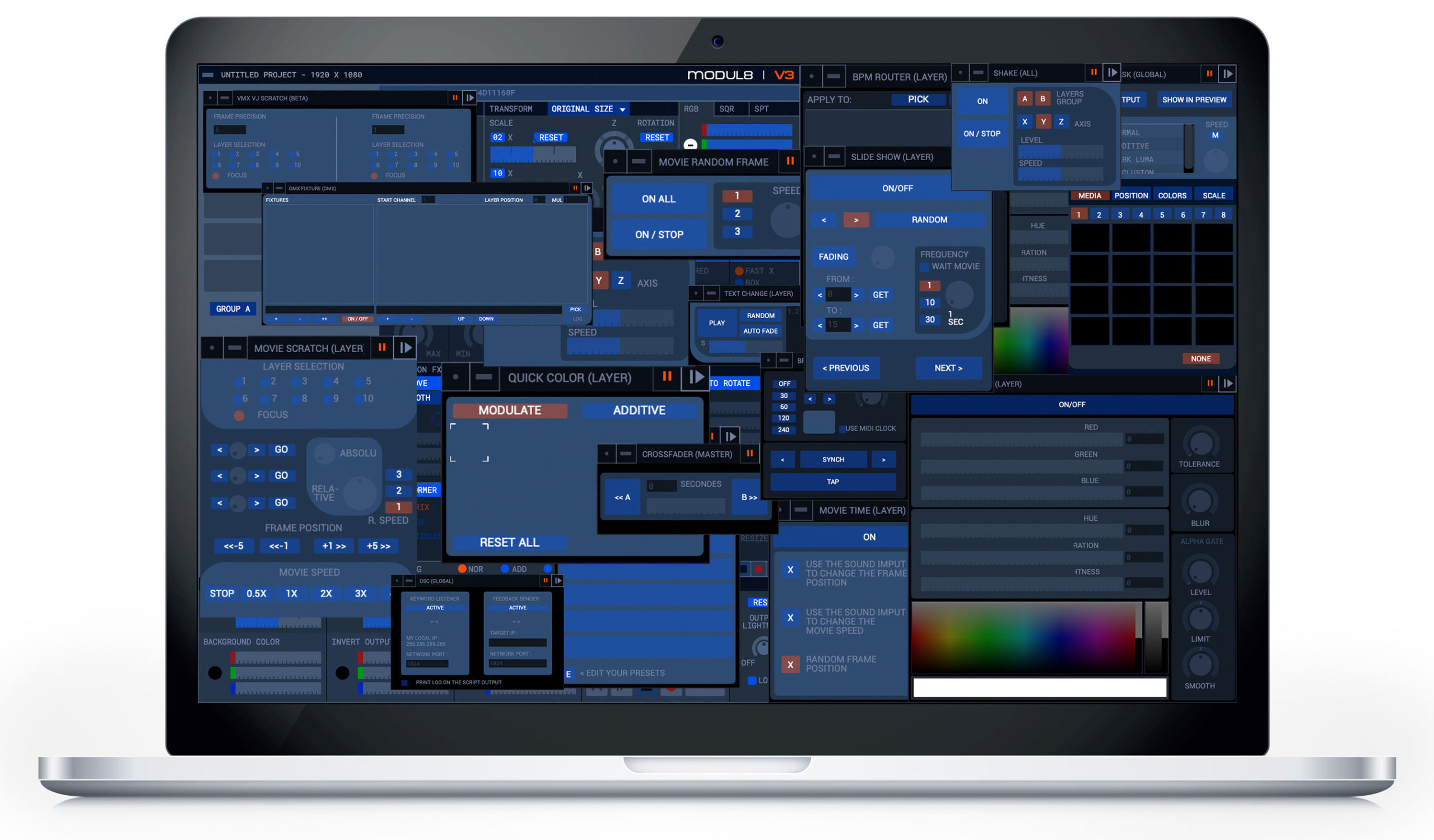
All main functions available on one single panel for optimal accessibility.

Up to 10 different layers, each one containing its own settings, effects, medias.

Mix the layers together with progressive transparency.

Move, copy or re-order the layers.

Store the current context in the set bank and restore it with a single mouse click.

Full midi support (three mapping modes: active layer, per layer, per layer and layer set). Link any midi message to any element of the user-interface. Linking is done automatically simply by clicking on the user-interface element and sending the midi message.

Full direct keyboard support. Link any key to any element of the user-interface. Linking is done automatically simply by clicking on the user-interface element and pressing the key.

Split your layers in two groups A/B and cross-fade from one group to another.

An advanced pre-visualization panel that can be used to move your media, prepare the mix before sending it to the final output, see a layer group while you are projecting another and more.

The final composition can be redirected to a full-screen view on the main screen or on a secondary screen or to a resizeable moveable window.

An advanced multiple-output panel allows you to do very flexible multiple projections

A media panel allows you to drag and drop your media files.

See informations about your media including a visual preview.

The master panel can be used to apply global settings to the whole composition.

Load and save the current settings.

Multiple workspaces to manage advanced module setup

 
  FEATURES

Univeral application optimized for Intel and PowerPC

Supports almost all 2D medias including all quicktime codecs, live video capture, flash 5 animation and all the most common 2D image formats.

Import full per-pixel transparency (as long as the media supports it).

Works in 32 bits ARGB color space.

Modulate in real-time all the color channels using substractive/additive factors in order to change color or global transparency level.

Apply five different types of luma-keys to generate real time per-pixel transparency on your media.

Advanced chroma-key support.

Works in full resolution for both the media and the final composition. (no scale down of the resolution ).

CoreImage and FreeFrame plug-ins support allowing the usage of hundreds of external filters.

Real time filters for contrast and saturation that can be inversed to obtain negative effects.

Two real-time blur filters.

Two real-time brightness filters.

Flexible noise filter (on color or alpha-channel).

Three-dimensional matrix transformer.

Map your movie on a three-dimensional patch and apply transformations like displacement mapping, reshape (sphere, cylinder), including several fill modes like wire frame or points.

Apply sound input curves to the three-dimensional patch.

Per-layer logical record allowing the recording and the replay of per-layer user actions.

Global logical record that let you records hours of mix at no CPU and disk space cost.

Render the logical record to a quicktime movie.

Direct capture mode allowing you to render to a quicktime movie while you are mixing.

Change the speed and the play direction of your movie.

Set the loop mode type of your movie : normal, loop or ping-pong.

Spatial transformation of your movie on three different axis allowing perspective, scale, rotation, translation, etc.

Automatic motion and colorisation of the media with full control over speed, rate, space, and size.

Automatic effects can all be combined together.

Create tiled mirrors of your medias at nearly no performance cost.

Link the automatic effects to the sound input.

A global trace mode where the movie acts as painting brushes on the background.

Live video capture that can be used just as any other media type.

Apply time transition between media changes

An integrated painter allows you to draw directly to your composition and even create stop motion animation.

Movie scratch module

Special filter module which supports per parameter animation. Can be used for all Modul8, FreeFrames and CoreImage filters.

Very advanced multi-output system

Flexible BPM with midi clock support, tap, etc. that can be routed to nearly any Modul8 functionalities.

A network module to pilot several Modul8 over a local network

Mask mechanism that can be used to apply an media as a mask in front of a composition

Anti-aliasing (as long as it is supported by your graphic card)

 
  EXTENSIBLE

An advanced module architecture that let you extend the feature set of Modul8.

Fully scriptable in Python.

An integrated module editor that let you create your modules straight from the inside of the application.

An interface-builder that let you build your own user-interface to customize Modul8 with full midi/keyboard mapping support.

A script editor that allows you to test your work in real-time : change your script, see the result in the composition.

An online mechanism to share the module with other users.

 
  PERFORMANCE

All rendering, compositing and transformation is done using the GPU of your graphic card.

All the pixel filtering functions have been optimized for optimal speed on the PowerPC and Intel processors.

The application is fully multithreaded to avoid latency between video decompression and GPU rendering. Multi-threading has been carefully balancing to obtain optimal performance on single processor machines and multi processor machines.

Mechanism to pre-buffer critical area of the movie to lower as much as possible latency between loops, media swaps, etc.

State of the art memory system with three different strategies that can be controlled by the user: decompressed in memory, compressed in memory and streamed from disk.

All the animations and effects are time based : faster is your machine, smoother is the animation.

 
  REQUIREMENTS

The minimum recommended configuration is :

MacOS 10.4.8 (Tiger) or higher (Leopard).

(Modul8 V2.0.3 still available for 10.3.9 users).

Quicktime 7.1.3 or higher

G4 1 ghz or higher processor (modul8 is universal)

AGP or PCI-EXPRESS 3d accelerated video card with at least 64 Mbytes of VRam

(Pci-express video cards is needed for multiprojection)

Minimum of 1GBytes of RAM.